

The orifice plate is one of the most common and low-cost methods for measuring fluid flow rate. It works with a small orifice plate inserted into a pipeline. As the fluid passes through this hole, a pressure difference occurs. The flow rate is calculated by measuring this pressure difference (∆P).
In practice, the flow calculation is based on more than a simple Bernoulli equation. Real fluids experience viscosity effects and energy losses, especially near the sharp edge of the orifice. As the fluid accelerates through the restriction, the streamlines contract to a smaller effective area known as the vena contracta. The actual minimum cross-section is slightly downstream of the physical orifice bore. Because of this contraction and subsequent expansion, a discharge coefficient (Cd) is introduced into the flow equation. This coefficient accounts for non-ideal behavior and depends on Reynolds number, beta ratio (orifice diameter to pipe diameter), and plate geometry. Without correctly applying Cd values derived from standards such as ISO 5167, the theoretical flow rate can deviate significantly from reality.
Measurement accuracy is highly sensitive to installation conditions. Upstream disturbances—such as elbows, reducers, valves, or partially open dampers—can distort the velocity profile before the fluid reaches the orifice plate. A non-uniform velocity distribution leads to erroneous differential pressure readings. For this reason, standards specify minimum straight pipe lengths upstream and downstream of the plate. Flow conditioners may also be installed when space is limited. In industrial plants, ignoring these piping requirements is one of the most common causes of unexpected measurement deviations.
To determine the flow rate of the fluidformed in the system pressure difference is measured and this difference is converted into flow rate using the relevant theoretical formulation. Pressure difference occurs as a result of changes in the speed of the fluid, and this change is directly related to the flow rate within the framework of the principles of fluid mechanics. The measured pressure difference values are placed in a suitable mathematical model, taking into account the geometric and physical properties of the system, and thus the instantaneous or average flow rate of the fluid is calculated precisely.
C.d.: Discharge coefficient
A.0: Area of orifice hole (m²)
ΔP: Pressure difference between the two sides of the orifice (Pa)
ρ: Density of the fluid (kg/m³)
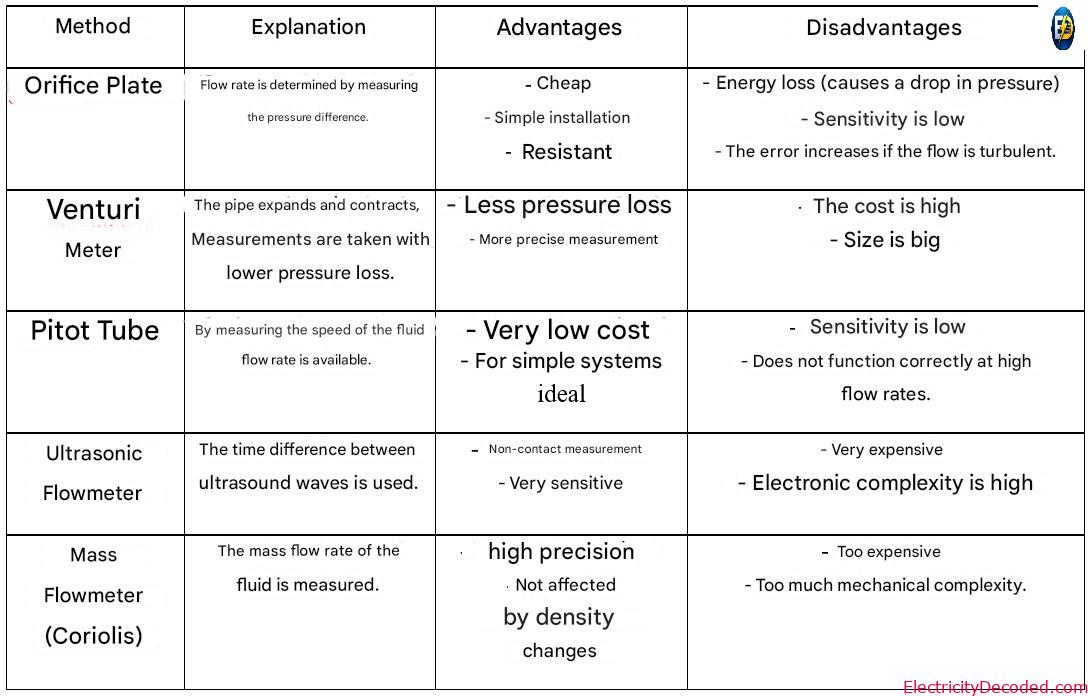
When evaluated from an economic perspective, orifice plates come to the fore especially in applications where the budget is limited. Relatively low production costs and the fact that they can be produced in a short time with precision machining machines (e.g. CNC machines) make these elements advantageous in terms of cost-performance. Additionally, since they do not have a complex structure, high efficiency can be achieved in production processes.
Material selection is not only about mechanical strength. In corrosive or erosive environments, the sharp upstream edge of the orifice must maintain its geometry. Even slight rounding of this edge alters the discharge coefficient and affects calibration. For steam applications, thermal expansion must also be considered when defining plate thickness and bore diameter. Stainless steel grades, alloy steels, or even special coatings may be selected depending on fluid composition and temperature. Long-term dimensional stability directly influences measurement repeatability.
In terms of durability, orifice plates can be easily designed to be used in high-pressure systems. It is possible to reach the desired structural strength level with appropriate material selection and thickness determination. This provides reliable and long-lasting use in industrial environments.
An orifice assembly typically consists of more than just the flat plate. The complete measurement setup includes pressure tapping points (flange taps, corner taps, or D and D/2 taps), impulse lines, a differential pressure transmitter, and sometimes a three- or five-valve manifold for maintenance and calibration. The positioning of pressure taps determines the reference points for ∆P measurement and slightly influences calculated flow. Impulse lines must be properly routed to avoid condensate accumulation in gas service or vapor pockets in liquid service. Small installation details can introduce significant zero shifts in the transmitter output.
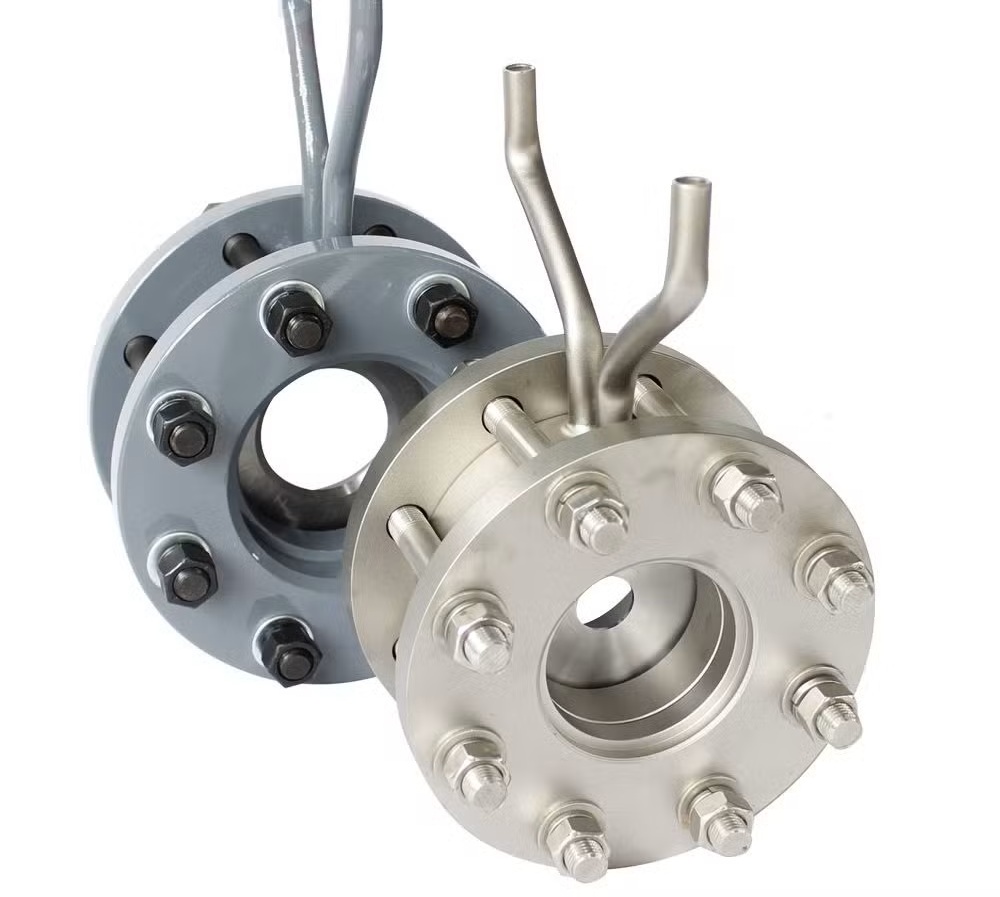
In terms of measurement accuracy, orifice plates can generally operate with margins of error ranging from ±1% to ±5%. This level of accuracy is considered sufficient for many technical applications, allowing to meet basic flow measurement needs without increasing the complexity and total cost of the system. Additionally, thanks to their compact structure, they save space and are very easy to integrate into existing systems.
For all these reasons, orifice plates; It has a wide range of usage as an economical, practical and reliable measurement solution, especially in industrial flow measurement systems, process control applications and engineering test infrastructures.
One inherent limitation of orifice plates is permanent pressure loss. Unlike some other differential pressure flow elements, the energy dissipated due to turbulence and flow separation downstream of the plate cannot be recovered. This permanent loss translates into additional pumping or compression energy requirements over time. In large-scale continuous processes, the operational energy penalty may outweigh the initial low investment cost. Therefore, lifecycle cost analysis—considering both capital expenditure and long-term energy consumption—provides a more realistic evaluation of whether an orifice plate is the optimal solution for a given application.
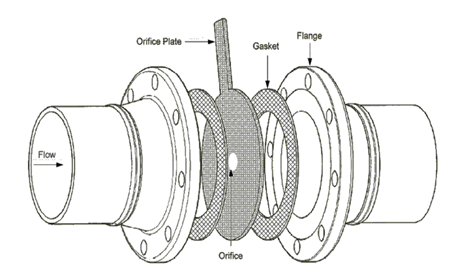
Figure 1: Orifice Plate Placement
Figure 1 schematically shows the structure in which the orifice plate is placed in a flow line. The orifice plate located in the middle is a flat metal plate and it limits the passage of the fluid thanks to the circular orifice hole in its center, thus causing a pressure difference before and after the plate. This pressure difference is used in flow rate calculations. The flow direction moves from left to right, and the paddle part at the top of the plate is generally used to show the direction of the orifice and to place an information label on it. The orifice hole is the critical region where the speed of the fluid changes, and the kinetic change occurring here is reflected in the pressure according to Bernoulli’s principle. Gaskets located on both sides of the orifice plate are used to seal the system.
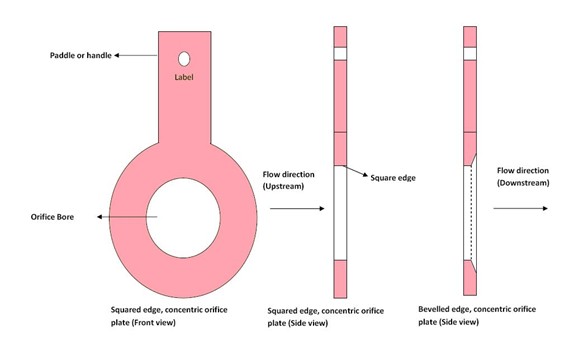
Figure 2: Orifice Plate Sections
In Figure 2, concentric (concentric) the structure of the orifice plate and its arrangement according to the flow direction are detailed. In the front view on the left, there is a round hole in the middle of the orifice plate, which consists of a circular plate, allowing the passage of fluid. Into this holeorifice holeIt is called ” and is placed in the exact center of the plate. At the top of the plate “paddle” or “handleThere is a handle-shaped extension called “”. This extension makes it easy to mount or remove the plate from the pipeline.
In the middle and right side views, the cross-section of the plate and its relationship with the flow direction are shown. square edged In the plate (squared edge), the side where the fluid comes (upstream) has a flat and sharp edge. This structure creates a sudden narrowing in the fluid passage, creating a pressure difference and allowing accurate flow measurement.
In the beveled edge plate, there is a curved structure on the outlet side. This slope ensures that the plate is installed in the correct orientation and provides benefits such as resistance to flow and reduced turbulence. In both side views, the flow direction is indicated by arrows; This is critical to correct plate placement during system assembly. Thanks to this structure, the orifice plate stands out as a low-cost, compact and durable flow measurement element.