

We can say that it is useful to understand the nature of atoms and subatomic particles by accelerating subatomic particles almost to the speed of light, and then colliding these accelerated particles. This is actually a very simplified definition. As we know, it is impossible to reach the speed of light under today’s conditions. Although we cannot accelerate a particle or any substance to the speed of light, we can accelerate it to a speed very close to the speed of light. Although what we mean by a very close speed here is 99% of the speed of light, even this 1% difference is a bigger difference than you can imagine. However, reaching speeds so close to the speed of light is a challenging process in itself. In addition, it also collides particles at these speeds and observes this. We can say that analyzing the results and finding solutions to today’s problems are among the challenging parts of this job.
The purpose of particle accelerators is described in an exaggerated manner, such as revealing the secrets of the universe. We can say that it was made to make sense of the universe by understanding the structure, behavior and different states of subatomic particles found in nature. Apart from experiments related to physics to understand the universe, it is also used in fields such as medicine and material science. We can give proton therapy applied in cancer treatment and the examination of materials at atomic levels as examples of this.
The basis of the working principle of particle accelerators is the electric field and magnetic field theory. An electric field is used to accelerate charged particles, and a magnetic field is used to keep the accelerated particles in the desired orbit. To be more detailed, electric fields provide kinetic energy to the particles thanks to the electrical force it applies to the particles. Generally, electric fields are created using radio frequency and are synchronized according to the time the particles pass through that field. Thus, each time the particles pass through that electric field, their kinetic energy and therefore their speed will increase. Well, let’s say we accelerated the particles enough. Won’t these particles get out of control?
After all, we are talking about a speed very close to the speed of light. This is where the magnetic field comes into play. Powerful electromagnets are often used in particle accelerators. The reason for this, of course, is that the particles reach very high speeds. Many powerful electromagnets are placed in the system to keep these increasingly energetic particles in the desired orbit. We can say that the strength of the magnetic field created by electromagnets depends on the speed of the particles.
Briefly, we can explain the working principle of particle accelerators by colliding particles that are accelerated by an electric field inside specially made tunnels and kept in alignment or orbit with a magnetic field, when they reach the desired energy level and the desired work is achieved by releasing greater energy.
How Do Particle Accelerators Actually Work?
At first glance, the idea sounds simple: take a tiny particle, push it to an extreme speed, and smash it into something. But the reality is far less dramatic and far more technical. You are not just “speeding something up.” You are controlling charged matter at energies where classical intuition starts to fail.
Reaching 99% of the speed of light may sound like a small gap from 100%, but that remaining 1% is where physics becomes unforgiving. As particles accelerate, adding more energy does not increase their speed in a proportional way. Instead, their relativistic momentum grows significantly. Engineers do not chase the speed itself — they chase energy. Because in high-energy physics, energy is resolution. The higher the energy, the deeper you can probe the structure of matter.
And that is the real objective.
Acceleration Is Not Just “Applying Voltage”
In principle, an electric field accelerates a charged particle. That part is straightforward. If you place a proton in an electric field, it experiences a force. Force leads to acceleration. Basic electromagnetism.
But particle accelerators do not use static electric fields the way a simple capacitor would. They use radio-frequency (RF) cavities. These cavities generate oscillating electromagnetic fields that must be perfectly synchronized with the particle bunches passing through them. Timing matters. A lot.
If the particle arrives at the wrong phase of the oscillating field, it will lose energy instead of gaining it. So the system continuously adjusts frequency, phase, and amplitude. We are talking about synchronization at nanosecond scales. Sometimes even tighter.
This is not just physics. It is high-precision control engineering.
Why Don’t the Particles Fly Off the Track?
Fair question. Once a charged particle reaches relativistic speeds, even the slightest deviation can cause beam instability. That is where magnetic fields take over.
Magnetic fields do not increase speed; they bend trajectories. The stronger the magnetic field, the tighter the curvature. In circular accelerators, huge electromagnets are arranged along the beamline to keep particles confined to a controlled path. If energy increases, magnetic strength must increase as well. Otherwise, the particle beam drifts outward.
Facilities like CERN operate massive synchrotron systems such as the Large Hadron Collider, where superconducting magnets generate extremely strong magnetic fields. These magnets are cooled to temperatures just above absolute zero. Not because it sounds impressive, but because superconductivity eliminates electrical resistance. Without that, energy losses would be enormous.
Cryogenics, vacuum systems, RF electronics, feedback control — all of them must work together. If one parameter drifts, beam quality degrades. Sometimes instantly.
A Section Inside the Large Hadron Collider at CERN
There are two types of accelerators. Linear accelerators are positioned on a linear line, as their name suggests. The main purpose of this type of accelerator is to accelerate particles rather than colliding them. Here, the particles are accelerated by the electric fields formed between the electrodes arranged in a row. In the medical field, such accelerators are used especially for cancer treatments. The longest linear particle accelerator in the world is at Stanford University in California, USA. SLAC (Stanford Linear Accelerator Center) has a length of approximately 3 km and was established in 1966 and hosted the physics experiments of the period. This linear particle accelerator still continues its operations, except for the collision process.

Fermilab Accelerator Laboratory in America and the Particle Accelerator Tevatron in it
In fact, when we hear the concept of particle accelerator, circular accelerators are more likely to come to mind. These are the type of accelerators we see in movies and TV series. Circular accelerators have a more suitable structure for colliding particles. Particles inside large circular tunnels are accelerated by electric fields and continue to move in circular orbits with the help of powerful electromagnets. Finally, when the particles reach the desired speed, they collide head-on, releasing a great deal of energy. As a result of this collision, data is obtained with advanced detector systems. As a result of the data obtained, a deep analysis process begins. Whether a new particle is formed after the collision, whether the experiment agrees with known theories, whether there is a substance or force that has not been seen before, are some of the results that scientists are trying to reach with the data obtained. Perhaps everyone has heard of it at least once, the Large Hadron Collider at CERN is the largest particle accelerator in the world.
Collisions: Controlled Chaos
When two high-energy particle beams collide, something interesting happens. Their kinetic energy converts into mass and other forms of energy. New particles may appear for fractions of a second before decaying.
But detectors do not “see” particles like cameras capture light. They register traces. Energy deposits. Ionization paths. Each collision generates a complex signature inside layered detector systems.
And here is something often overlooked: billions of collisions can occur every second, but only a very small portion are actually recorded. Real-time filtering algorithms decide which events are worth storing. Otherwise, the data volume would be unmanageable.
Particle physics today is as much about data science as it is about fields and forces.
Vacuum: The Invisible Requirement
Another detail that rarely gets attention is the vacuum inside the beam pipe. If residual gas molecules remain, particles can scatter unexpectedly. That leads to energy loss and beam instability.
So accelerators operate under ultra-high vacuum conditions, sometimes comparable to interplanetary space. Maintaining that vacuum across kilometers of tunnel is not trivial. It requires continuous monitoring and sophisticated pumping systems.
People imagine giant magnets. They rarely imagine vacuum engineering. Yet both are equally critical.
Beyond Fundamental Research
It is easy to associate particle accelerators only with fundamental physics and questions about the universe. And yes, that is part of the story. But accelerators are also practical tools.
In medicine, linear accelerators are used for radiation therapy. In proton therapy, charged particle beams target tumors with remarkable precision. In material science, synchrotron radiation allows atomic-level analysis of structures. Semiconductor manufacturing, sterilization processes, advanced imaging techniques — all benefit from accelerator technology.
In many cases, the engineering innovations developed for large research facilities end up influencing industrial applications years later.
Did You Know This?
You may remember the tube televisions we used to have in our homes. What would you think if I told you that these tube televisions are actually particle accelerators? Of course, it is quite simple and small compared to today’s particle accelerators. In addition, today’s televisions work with different pixel techniques. These tube televisions have a Cathode Ray Tube (CRT) mechanism. Electrons are thrown into the void from the cathode behind the television. These electrons are accelerated and directed and hit the phosphor-coated surface on the screen. As a result of each electron hitting the screen, a pixel shines, and we obtain the image by shining these pixels. This must be the reason for that little electric shock when we touched the screen with our hand after turning off the TV in the past.
Large Hadron Collider | LHC (Large Hadron Collider)
CERN, located on the borders of Switzerland and France, has the world’s largest particle accelerator. It would be unfair not to mention this machine when talking about particle accelerators. There are around 30000 accelerators in total around the world. The accelerator we will talk about is the largest and most powerful among them. The Large Hadron Collider is a circular accelerator approximately 27 km long and 175 meters deep. The first collision at the accelerator, which was established in 2008, took place in 2010. Since then, it has continued its activities at full speed and is the apple of the eye of scientists.
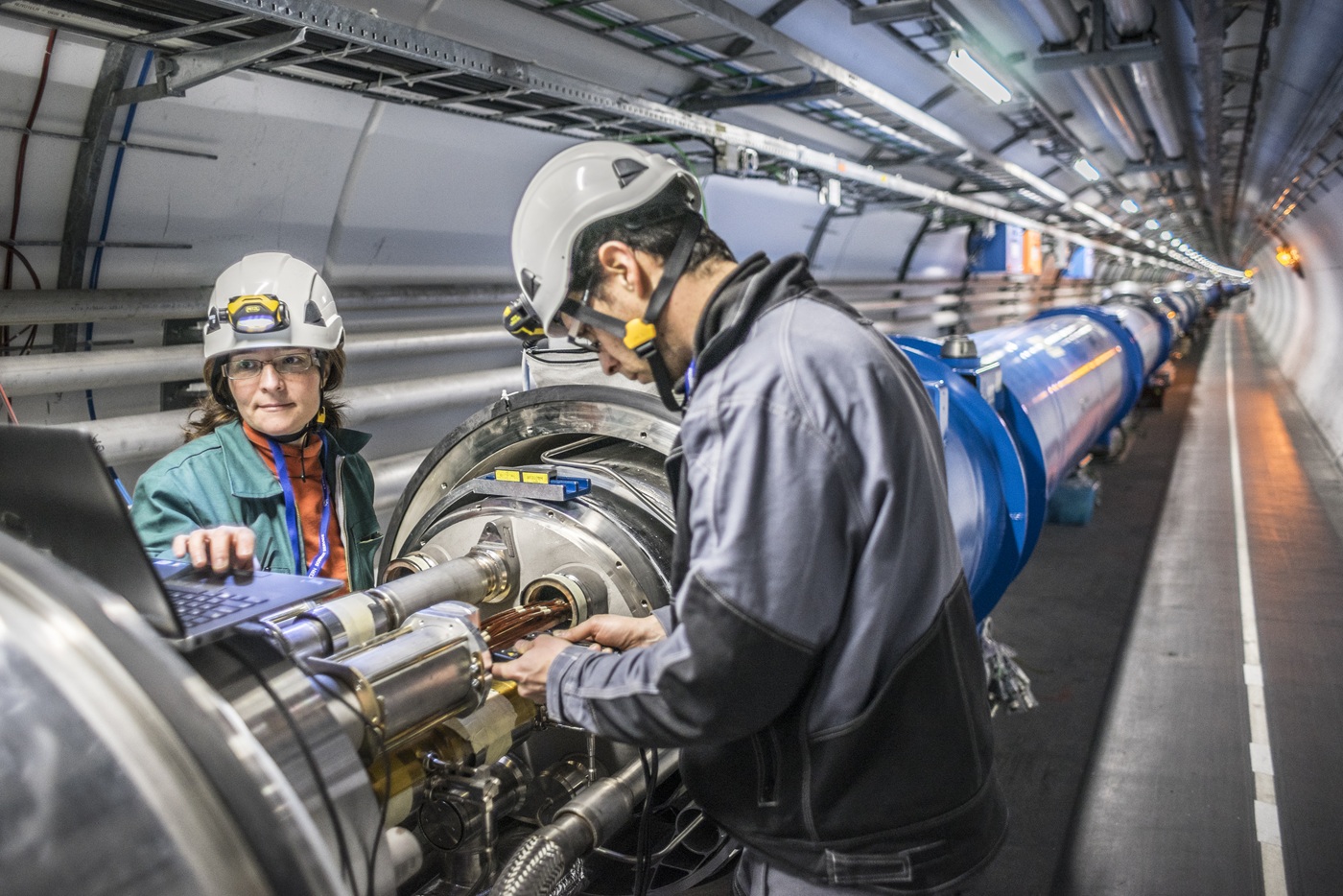 Engineers Working at the Large Hadron Collider
As additional information, famous physicist Stephen Hawking said in a statement about particle accelerators; He stated that these machines are important for understanding the building blocks of the universe, and that they are the closest machine humanity has invented to a time machine.
Science continues to guide us non-stop. Humanity must constantly update and develop itself in the light of science. Who knows, maybe we will soon be able to build a more advanced machine than particle accelerators.
So, How Do Particle Accelerators Work?
They work by transferring energy to charged particles through precisely synchronized electric fields, steering them with powerful magnetic fields, isolating them inside ultra-high vacuum systems, and finally bringing them into controlled collisions where energy transforms into new physical phenomena.
But describing it this way still feels incomplete.
Because in practice, a particle accelerator is not just a physics experiment. It is a massive integration of electromagnetics, materials science, cryogenics, vacuum engineering, RF systems, and advanced data processing — all operating at the limits of precision.
It is less about smashing particles.
And more about controlling nature at a scale where even tiny errors become enormous.
Source
[1] CERN (Conseil Européen pour la Recherche Nucléaire) (1954).
[2] New York Times; As the Large Hadron Collider Revs Up, Physicists’ Hopes Soar by Dennis Overbye, 22.07.2022.
[3] US Department of Energy, How Particle Accelerators Work, 18.06.2014.
[4] Evolution Tree, What is Particle Accelerator? From Tube Televisions to CERN, Particle Launching Technologies – Ali Mert Turaçlar, 03.03.2021.