

The continuity and reliability of electrical energy in industrial facilities is critical for production efficiency and operational safety. Ensuring energy continuity is among the main priorities of the business, especially in systems operating at medium voltage (MV) level. Although classical grounding methods provide great advantages in terms of safety, operational grounding is a matter of debate in some industrial applications in terms of ensuring energy continuity in case of failure.
In industrial environments where even a few seconds of interruption may lead to significant financial losses, the choice of grounding philosophy becomes a strategic decision rather than a purely technical one. Production lines with continuous processes — such as furnaces, chemical reactors, or rolling mills — may suffer equipment damage or product loss if energy supply is suddenly interrupted. For this reason, isolated networks are often evaluated not only from a protection standpoint but also from an operational continuity perspective.
One of the prominent solutions at this point is the grounding scheme called isolated network. In an isolated network, the neutral point of the transformer or generator is not directly connected to ground; The system is connected to ground via phase ground capacitances. Thanks to this structure, in the event of the first phase-ground fault, no current flows through the system except for very small cable capacitive currents, and current-based protection devices do not come into play. Therefore, the facility continues to operate without interruption. Isolated networks stand out with these features in areas such as chemistry, mining, metallurgy, paper, cement and healthcare sectors that require energy continuity.
When the first phase-to-ground fault occurs in an isolated system, the fault current is limited mainly to the capacitive current flowing through the healthy phases. Since this current is typically in the range of a few amperes depending on the total network capacitance, thermal and mechanical stress on the equipment remains minimal. This allows operators to continue running the process while maintenance teams locate and eliminate the fault in a controlled manner. However, this operational flexibility requires continuous insulation monitoring to prevent unnoticed deterioration.
In normal operation of the isolated network, in a fault-free state, when balanced three-phase voltages are applied to the network, the capacitive charging currents (IC0) occurring in each phase are equal to each other and there is a 120° phase difference between them. Likewise, the phase-ground voltages are of equal magnitude and are located with a 120° phase shift relative to each other. Therefore, under normal operating conditions, the system continues to operate stably and the capacitive coupling with the ground is considered symmetrical.
Because the first ground fault does not cause an immediate shutdown, insulation monitoring devices (IMDs) become an essential component of isolated networks. These devices continuously measure insulation resistance between live conductors and ground and provide early warning when insulation levels fall below predefined thresholds. Without proper monitoring, a second fault on another phase could result in a phase-to-phase short circuit, leading to severe damage and unexpected outages.
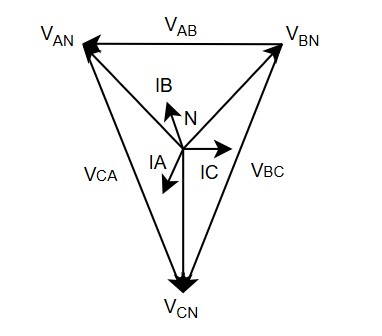
Figure 2: Isolated network vector diagram
From a system behavior standpoint, the symmetrical capacitive coupling to ground under normal operating conditions ensures that no zero-sequence current circulates through the network. However, once a single phase-to-ground fault develops, the voltage distribution shifts: the faulted phase voltage to ground collapses close to zero, while the healthy phases rise approximately to line-to-line voltage with respect to ground. This temporary overvoltage stress on healthy phases is one of the key technical considerations in insulation coordination design.
In isolated networks, when one of the system conductors touches the ground, current flow stops through the capacitance between that conductor and the ground; because there is no longer a potential difference between the capacitance ends. On the other hand, the voltage on the capacitance of the two phases remaining faultless to ground increases from the phase-neutral level to the phase-phase level. This causes the capacitive charging current (IC0) to increase by a factor of √3 in two fault-free phases. Additionally, the phasor diagram of the phase-to-ground voltages changes; While normally there is a phase difference of 120°, in case of fault this angle decreases to 60° (Figure 4).
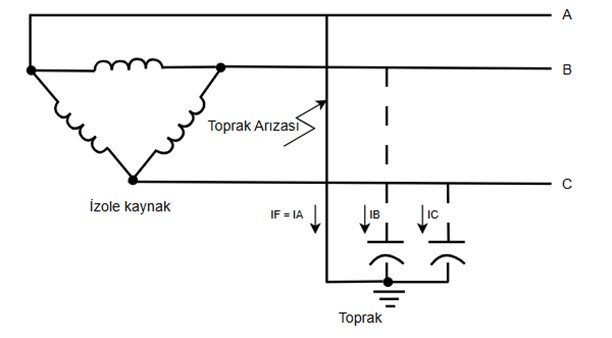
Figure 3: Single phase earth fault in isolated network
Despite its continuity advantages, the isolated network concept is not free from limitations. As cable lengths increase and the total capacitive current of the system grows, fault detection becomes more complex and touch voltage risks may rise. In large installations, additional protective measures such as arc suppression coils or high-resistance grounding alternatives may be evaluated to balance safety and continuity requirements.
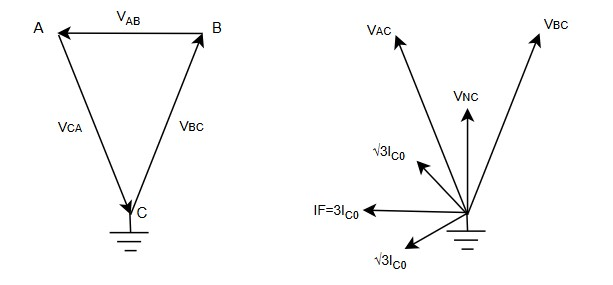
Figure 4: Vector diagram in case of single phase earth fault in isolated network
Since the phase voltages are symmetrical in normal (fault-free) operating conditions in isolated networks, zero sequence voltage (V0) does not occur. However, when a single phase-ground fault occurs, the symmetry between the phase voltages is broken and V0 voltage appears. This feature makes it possible to use V0-based protection functions to detect earth faults in isolated networks.
The main grounding methods used in electrical systems include direct grounding, resistance grounding, and impedance grounding.
In the direct grounding method, the neutral point of the transformer or generator is directly connected to the ground. In case of ground fault, the fault current reaches very high levels and the protection devices detect the fault, send a trip command to the relevant breaker and quickly open the circuit. The biggest advantage of this method is that the fault is easily detected; However, due to high fault currents, large thermal and dynamic stresses occur on the equipment. Direct grounding is very rare in industrial facilities.
In the grounding method through resistance, a resistance is connected between neutral and ground. Thus, the fault current is limited. In low resistance systems, fault currents of several hundred amperes are possible and protection devices are activated quickly. In high resistance systems, the fault current is kept at very low levels; The system continues to operate in the event of the first failure. This provides an advantage in facilities where production continuity is important.
In the impedance grounding method, an inductor (reactance) is used instead of a resistor. In this way, the fault current is both limited and temporary overvoltages are kept under control. It is generally preferred in large-scale medium voltage networks.
The common feature of directly grounded, low impedance grounded and resistor grounded systems is that a certain level of current flow is provided in the event of a fault and the protection devices open the circuit. Although this situation provides an advantage in terms of security, it creates an interruption in terms of energy continuity. Isolated networks stand out at this point: The fact that the system continues to operate in the first failure makes them attractive for industries that require energy continuity.
Advantages of Isolated Business
The biggest advantage of isolated operation is that the system can continue to operate uninterrupted in the event of a first phase-ground fault. In directly grounded systems, the circuit is interrupted at the first fault, while in isolated enterprises, production continuity is maintained because the fault current is very low. This feature is of great importance, especially in sectors such as chemical plants, metallurgy, mining enterprises, refineries and hospitals where production continuity is critical. However, for this advantage to be meaningful, the insulation levels of the panels and equipment must be selected to withstand at least √3 times the operating voltage, that is, based on the upper voltage level. Otherwise, as long as the fault continues, voltage increases occurring on non-faulty phases may strain the equipment insulation and jeopardize reliability.
Another important advantage is that the fault current remains at low levels. Since the neutral point is not directly connected to ground, at the first fault current flows only through the natural capacitive properties of the cables. Since these currents are generally around a few amperes, the strain on the equipment is reduced and short circuit levels remain limited. Thus, the life of medium voltage cables and switchgear is extended.
In isolated operated systems, since there is no power outage in the event of the first single phase ground fault, operational continuity is ensured and the fault can be eliminated in a planned manner. However, it should be taken into consideration that phase-to-ground voltages increase in this process and long-term faults may cause temporary overvoltages.
There is a risk that phase-to-ground faults occurring in grounded systems may turn into a three-phase short circuit. In such a case, voltage drops occur at the low voltage (LV) level, which causes the contactors of the LV motors to remain de-energized, even for a very short time, and therefore all motors to be disabled. Even if the protection periods are kept longer in resistance grounded systems, voltage collapse on the LV side may be inevitable during this period. The ideal solution to avoid this negativity is to feed the control and command circuits of LV motors through uninterruptible power supplies (UPS). Thus, contactor coils and on-off command circuits are not affected by voltage drops during faults and the continuity of the system is maintained. However, when there is no power supply via UPS, an earth fault occurring on the MV side collapses the entire LV side and causes undesirable shutdowns in the operation. In isolated systems, since the current remains at low levels in the first phase-earth fault, there is no voltage collapse on the LV side; In this way, the operating continuity of the LV motors and the facility is maintained. Therefore, one of the most important advantages of isolated operation is that the system can continue to operate uninterruptedly, especially at the LV level, in the event of the first earth fault.
Disadvantages of Isolated Business
The most important disadvantage of isolated operation is the difficulty in detecting the first earth fault. Since the fault current is very low, classical overcurrent relays do not activate. Therefore, insulation monitoring devices must be used to detect the faulty point. Otherwise, the first fault may be overlooked and when a second fault occurs in a different phase, a short circuit occurs between the phases. This situation can cause very high fault currents, causing serious damage to both the equipment and operational safety.
As cable lengths increase in isolated networks, the capacitive effect of the system against the ground also increases. As a result, initial fault currents increase, which can make it difficult for insulation monitoring devices to accurately detect the fault. In addition, high capacitive currents make the harmonious operation of the protection scheme more complicated. In case of a fault, protection relays in parallel feeders may operate incorrectly due to capacitive currents passing through them, causing unnecessary power outages. Figure 5 shows that in case of a fault in one of the output feeders, Relay 3 in the parallel feeder operates from the sensitive earth protection (ANSI 51Ns/67Ns) function, causing its own breaker to open incorrectly and causing unnecessary interruption.
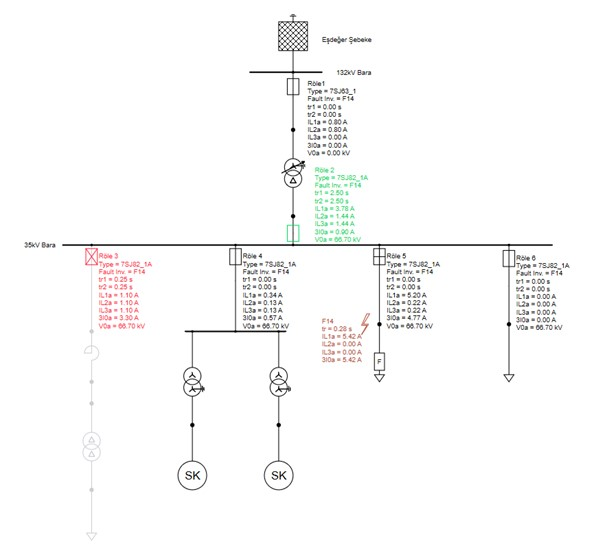
Figure 5: Relay malfunctioning due to sensitive earth protection function due to capacitive effect in case of a fault in the parallel feeder
If the panel operating voltage is not at a level that can safely meet the voltage increase (up to √3 times) that may occur with the increase in phase-to-ground voltages of non-faulty phases in the event of a phase-to-ground fault, the insulation material may be exposed to a voltage above the operating voltage for a long time. This may strain the panel insulation and cause damage to the equipment. Additionally, since fault currents remain at low levels in isolated systems, overcurrent relays may be insufficient to detect such faults. Therefore, in order to provide reliable protection, it is necessary to use protection functions based on zero sequence (V0) voltage and to generate an alarm and/or trip (trip) through this function. Figure 6 shows that in an isolated network, in the event of a phase-to-earth fault at the busbar, the input relay (Relay 2) opens from the V0 voltage function (ANSI 59) and clears this busbar fault, due to the very low short circuit currents.
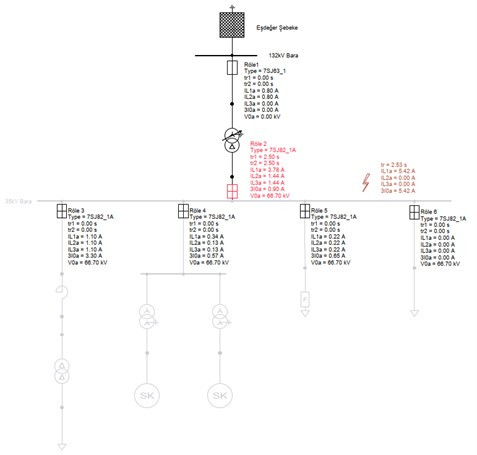
Figure 6: Use of protection functions based on (V0) voltage in isolated network
The economic and operational maintenance costs of isolated enterprises are higher compared to grounded enterprises. Insulation monitoring devices, special relays, fault detection systems should be installed and personnel should be trained on this subject. This situation increases both investment and operating expenses.
In isolated operated systems, since the fault current is very low in the first single phase ground fault, the system can continue to operate and planned intervention is possible. However, this increases the risk of temporary overvoltages in the system. Particularly recurring arc-ground faults (restriking ground faults) can create overvoltages reaching several times the normal voltage by creating resonance between the inductive reactance of the system and the capacitive effects with the ground. Although these faults occur with a small current, they are sufficient to maintain the arc and can lead to insulation failures at various points of the system, especially in motors.
In addition, ferroresonance is a nonlinear phenomenon that occurs as a result of the current reactance of transformers and system capacitances resonating, creating distorted waveforms with very high amplitudes. These two situations are considered important risk factors in terms of insulation safety and equipment durability in isolated operated power systems.
Finally, isolated business requires a complex business structure. While the fault can be easily found in directly grounded systems, additional methods are needed to determine the location of the fault in isolated systems. This may extend the fault resolution time.
Conclusion
Isolated networks in industrial facilities provide significant advantages in terms of energy continuity and reliability. Uninterrupted operation of the system in the first malfunction, low fault currents and reduced risk of fire make these systems attractive. However, fault detection difficulties, high short circuit currents in case of a second fault, insulation problems that may occur due to rising voltage, and investment costs are disadvantages that should be taken into consideration. Therefore, isolated networks are not a universal solution for the facility, but become an effective and reliable method when applied with correct engineering practices, isolation monitoring systems and trained personnel.
Ultimately, the decision to implement an isolated network depends on a careful assessment of process criticality, system size, and maintenance capability. In facilities where uninterrupted operation is essential and qualified monitoring infrastructure is available, isolated systems offer a practical balance between safety and reliability. However, they demand disciplined inspection routines and well-trained technical personnel to ensure long-term stability.