

It wouldn’t be wrong to say that e-mobility is the integration and optimization of transportation infrastructure suitable for electric vehicles, as electric vehicles enter our lives. If we think that e-mobility consists only of electric vehicles, then we would be making a mistake. After all, there are many needs such as we need to charge electric vehicles, we need charging connections and stations to charge them, we need to regulate the current we draw from the network in order to establish stations. We can say that doing all these at the most optimized level is the biggest goal of the concept of e-mobility.
Phoenix Contact stands out with the solutions and product groups it offers for sustainable e-mobility. With its products, it ensures that electric vehicles can be charged quickly, reliably and suitable for daily use. In fact, Phoenix Contact Group carries out its work in the field of e-mobility with a separate organization called Phoenix Contact E-Mobility. This actually shows the importance they attach to e-mobility, and therefore they can allocate more resources and time to this issue.
You can access the detailed brochure prepared by Phoenix Contact for e-mobility here: Charging Technology For E-Mobility
Phoenix Contact E-Mobility makes a difference with its CHARX product group, one of the solutions it offers to the sector. CHARX; It is a product group that includes connection, protection, power and control systems. Let’s examine these products and the systems they contain.
► CHARX Connect: It includes DC charging cables suitable for all performance classes from home chargers to HPC charging parks, robust and high-quality AC charging cables with ergonomic structure, universal vehicle charging inputs for AC and DC charging of all types of electric vehicles and modular type 2 charging sockets (with LED display, shutter and temperature sensor) for portable AC charging cable. You can examine DC charging cables and NACS, CCS and GB/T connectors used for fast charging of electric vehicles up to 1000 kW.
► CHARX Control: Includes high-performance DC charge controllers for state-of-the-art CHAdeMO and CCS charging stations, AC charge controllers prepared for vehicle-to-grid charging and calibration law, and universal use and vehicle-to-grid compatible charge controllers for all electric vehicles with CCS charging input. This smart control system has features such as current monitoring and error management, RFID authentication, connection to background systems with OCPP, plug & charge support, and compatibility with ISO 15118 and DIN 70121 communication protocols.
► CHARX Power: Includes power and distribution modules for efficient and scalable DC supply of fast charging stations, which are important for power electronics and power distribution. This group enables remote monitoring of charging infrastructure, load management and system performance monitoring.
► CHARX Protect: It includes protection equipment (AC/DC overcurrent protection relays, leakage current detectors, thermal and magnetic protection systems) that provide overvoltage protection by protecting charging points against damage caused by lightning strikes and switching operations on vehicles.
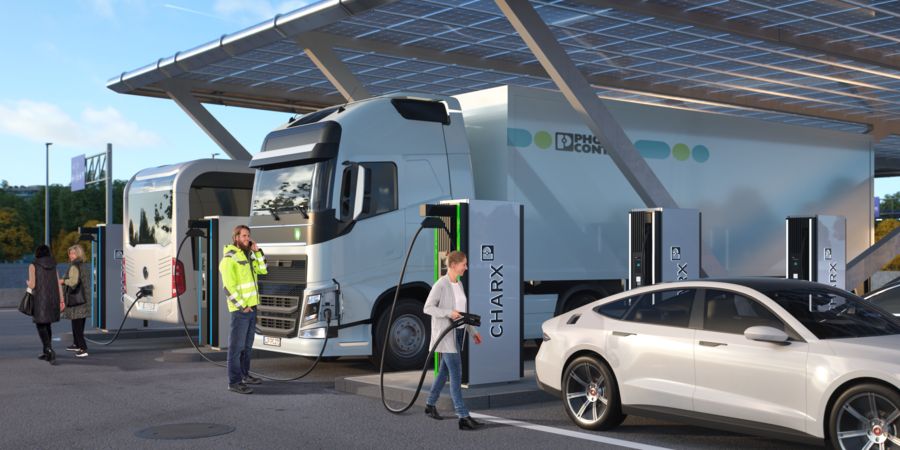
By combining maximum safety, reliability and durability, CHARX products have managed to greatly increase user comfort with seemingly complex add-ons. We cannot help but mention the convenience it provides during assembly thanks to its modular structure. CHARX products, from the charging station to the electric vehicle, are produced according to the specific needs of the e-mobility sector. In this way, it has managed to be an effective solution to specific problems. Phoenix Contact E-Mobility has made a name for itself in the market by offering comprehensive, specific and efficient solutions to its customers with its CHARX product range.
First, let’s examine what a combined charging system (CSS) is. As we know, there are different types of chargers in charging stations. AC charging is generally used, but there are also device types that use DC charging when high currents are required. Thanks to CSS, your electric vehicle can adapt to both AC and DC charging connectors. In short, we can say that it is the only universal charging interface for AC and DC charging. This means that there is no need for another interface. In this way, it provides great convenience to its users. Additionally, with the use of CSS, vehicle manufacturers significantly save on components, space and costs. This system, accepted in most of the world, has the highest degree of safety thanks to the actuator safety interlock and temperature monitoring. Now let’s talk about CSS charge inputs and their advantages.
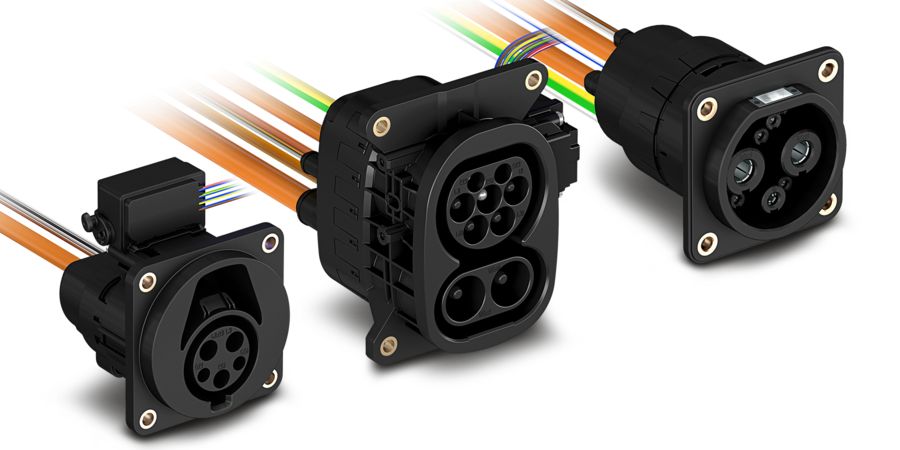
Advantages of CCS Charging Ports
► CCS charging ports work in harmony with fast charging technology with HPC (High Power Charging) feature, allowing your electric vehicles to be charged quickly. Electric vehicles with cable cross-sections up to 120 mm² can be charged continuously with 375 A via CCS charging inputs. Depending on other conditions such as ambient temperature, the way the cables are routed inside the vehicle or the application-specific charging profile, the electric vehicle can even be charged with higher charging powers of up to 700 kW for short periods in Boost Mode.
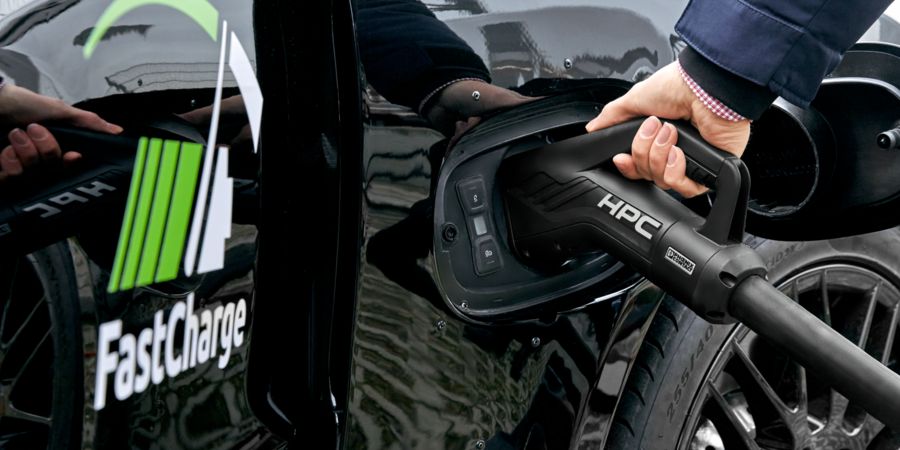
► PTC sensor technology in the AC region consists of a chain of resistors, each located at a contact. By detecting the relevant resistance values, safe shutdown is ensured when the limit temperature is exceeded. In the DC region, charging occurs with higher currents, so a precise temperature measurement is required. By placing a Pt 1000 sensor on both DC contacts, very precise temperature measurement is achieved. According to the evaluated measurement data, the requested DC charging current can be dynamically controlled by the vehicle. When the limit temperature of +90°C is exceeded at the contact, immediate shutdown is initiated.
► CSS charging ports have a long service life, proven by more than 10,000 installations. In addition, it reinforces its reliability in the market with its compliance with IEC 62196, SAE J1772, GB/T 20234 standards.
Charging Infrastructure
We mentioned that with the introduction of electric vehicles into our lives, the need for a charging infrastructure arose. Charging infrastructures, which have developed further compared to their early days, have now perhaps become a completely different sector that requires more innovative solutions. Phoenix Contact E-Mobility offers effective solutions in this sector as well. Especially with CHARX products, you can access everything you need for your charging infrastructure. Phoenix Contact E-Mobility offers you special solutions not only in infrastructure but also in all functional areas for your electric vehicle, from the charging station to charging your vehicle.