

The current carried in Medium Voltage (MV) switchgear panels, which are components of energy distribution and transmission networks, does not only create electrical effects. It also creates magnetic fields and thus eddy currents around the current-carrying busbars. The intensity and distribution of the magnetic field can directly affect the performance of the devices in the panel, electromagnetic compatibility and long-term safe working conditions.
In particular, as the current value increases, this effect in switchgear becomes more evident. For this reason, the effect of the current passing through the busbars on the magnetic field is an important parameter that should be taken into consideration during the mechanical design phase.
Magnetic field; It occurs when an electric current is passed through a conductive material (for example, current passing through a copper wire). This magnetic field is the region where the magnetic force is effective. [1]
Depending on the current carrying capacity, magnetic fields are formed in the current-carrying busbars and power cables of MV switchboards. According to Ampere’s law, which expresses the relationship between magnetic field and electric current, current passing through a conductor creates a circular magnetic field around the conductor. These magnetic fields can interact with other conductors, causing inductive losses and interference [2]. This negatively affects the switchgear facilities where panels are used, causing energy and efficiency losses.
Ampere’s Law:
B: Magnetic field intensity, (Tesla(T))
μ: magnetic permeability, (N/A²)
I: current passing through the conductor, (A)
r: distance to the conductor (radius), (m)
stated in Ampere’s Law B. The SI unit of magnetic field intensity is Tesla (T), which can alternatively be expressed as kg/(A⋅s²). Magnetic field intensity is the amount of current passing through the conductor (i) increases, it decreases as the distance from the conductor increases (as r increases).
Another parameter, μ magnetic permeability, also causes the magnetic field intensity to increase. Magnetic permeability; It is defined as the ability of a material to transmit a magnetic field, in other words, its conduction capacity. For this reason, the choice of materials used in current-carrying areas of the panels is of critical importance.
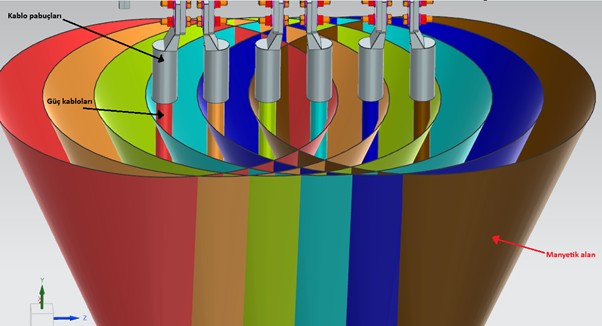
The magnetic field is simulated in the figure below. In the relevant image, 6 cable connection designs per phase are shared, and the magnetic field of each cable is shown in a different color. In the relevant image, it is seen that the magnetic field intensity is higher in the cables mounted in the middle position. However, as you move away from the center (towards the edges), the magnetic field intensity decreases.
In order to prevent the performance losses and interferences mentioned at the beginning of the article, chromium-nickel steel sheet alloys (X5CrNi18-10N+2B), defined as stainless steel, can be used during the mechanical design of MV panels.
The material cost of stainless steels is higher compared to galvanized sheet alloys. For this reason, using entirely stainless steel materials in the designs is not a correct approach in terms of production costs.
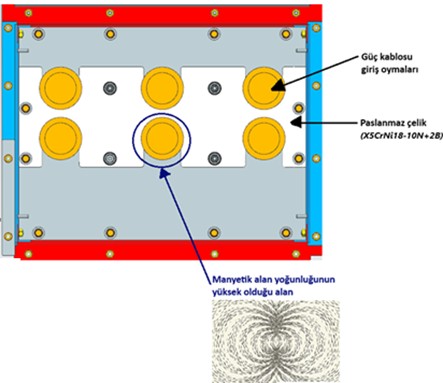
For optimum design; Since the intensity of the magnetic field B specified in Ampere’s Law decreases with distance from the conductor, the use of stainless steel should be considered only in the area closest to the conductor, where the magnetic field intensity is highest – where the radius r is lowest. The figure below is shared to serve as an example of this approach. As shared in the image, the part of the base sheet closest to the conductor is made of stainless steel in order to disrupt the magnetic field.
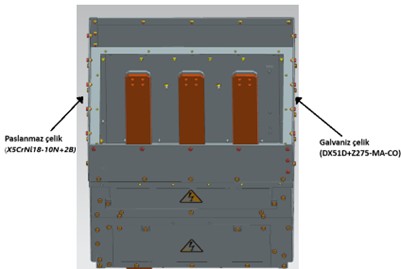
Apart from power cables, galvanized sheet and stainless steel sheet alloy are used together in the main body constructions where current-carrying busbars are located in the panel, thus preventing the temperature increase due to the magnetic field. For example, the figure below shows the use of stainless-galvanized steel sheet for current-carrying main busbars and is shared as a reference.
In order to correctly interpret the effect of magnetic fields increasing in parallel with the current capacity in the panels, the details of the magnetic permeability and magnetization properties of the stainless steel class are as follows.
Stainless Steels(X5CrNi18-10N+2B)
Chromium-Nickel alloy steels are classified as austenitic stainless steels because they contain high amounts of chromium (Cr) and nickel (Ni) in their structure. Materials in this class have the property of exhibiting paramagnetic behavior. Although steels are generally defined as a ferromagnetic material, they may exhibit paramagnetic behavior depending on the alloying elements they contain, differences in crystal structure and temperature. [3].
Paramagnetic behavior; It means that the steel material is weakly and temporarily magnetized when exposed to an external magnetic field, but the relevant situation disappears when the magnetic field is removed. [4].
Stainless steels minimize unwanted magnetic effects by limiting the intensity of the magnetic field (B) thanks to their low magnetic permeability (μ) and high magnetic resistance. As a result, the total magnetic field expected to occur within the panel is effectively reduced.
Another negative effect caused by magnetic fields in panels with high current carrying capacity is eddy currents known as Eddy Current.
Eddy Current; As the current value of the panel increases, they are known as cyclic currents, which occur especially in the areas where the power cable of the panel passes and negatively affect the performance of switchgear facilities by causing energy losses.
Eddy Current is induced inside conductive materials and creates a magnetic field that opposes the magnetic field change that creates it (Lenz’s Law).[5]. This causes the plant performance to be negatively affected. Another side effect is; It causes an increase in temperature in current-carrying busbars, causing a decrease in current-carrying capacity. In order to reduce the undesirable effects of Eddy Current, stainless steel and galvanized steel sheet design are used together in the areas where the power cable and main busbars of MV panels pass, ensuring high resistance to the magnetic field.
In addition to this, the cable clamps used to prevent direct contact of the cable insulation with the sheet metal and the maintenance of cable shielding up to the panel entrance also play an important role in reducing the effects of Eddy Current and temperature increase, creating a positive effect.

Cable insulation and cable clamp
Result and Analysis
► The magnetic field occurring in Medium Voltage electrical panels and Ampere’s Law, which gives the magnetic field size, were examined. As stated in the formulation, it has been explained that the magnetic field density is high in areas where the current passing through the conductor increases and the distance to the conductor decreases.
► Design solutions have been put forward in which stainless steel and galvanized steel materials are used together to prevent magnetic field effects and eddy currents, which increase in direct proportion to the current value.
► By examining the structure of stainless steels, information about their paramagnetic behavior depending on the chromium/nickel ratio in their content and the resulting magnetic resistance are highlighted.
► It has been analyzed from an engineering perspective that areas with high magnetic field intensity should be predicted during the mechanical design phase and the use of stainless steel should be applied only to these areas and production costs should be taken into consideration.
In addition, it has been noted that additional design applications such as cable insulation and shielding improve plant performance and reduce undesirable magnetic effects and temperature increases.
Source
[1] Physics 2: Electricity and Magnetism – Resnick, Halliday & Krane
[2] Electromagnetic Field Theory – Çolakoğlu, MR (2017) Nobel Academic Publishing.
[3] Metallurgical and Materials Engineering Fundamentals – Küçük, MA (2011). Nobel Publishing.
[4] Materials Science and Engineering, Chapter 20 Magnetic Properties – William D. Callister
[5] https://tr.wikipedia.org/wiki/Eddy_akımı