

Switching elements in high voltage, medium voltage and low voltage energy systems; It is frequently used in transmission and distribution networks, industrial facilities, energy production plants, renewable energy systems, petrochemical facilities, organized industry distribution network infrastructures and factories. These types of production facilities, transmission and distribution networks need sustainable energy and a sustainable business. In this context, the need to create operating environments that comply with the health, environment and safety rules of production facilities, transmission and distribution networks with their own dynamic operating structures according to business scenarios arises, and interface designs that will ensure this must be carefully made. These interfaces can be made electrically and/or mechanically, and electrical locking can be provided through conventional physical connections as well as through communication systems and a type of communication infrastructure called protection interface. The elements within the energy systems in these facilities appear as high/medium voltage panels, low voltage panels, generators, transformers, busbars, cables, drivers, motors, etc. Operation of facilities; According to the operating scenarios, switching of the breakers, disconnectors and earth separators in the high/medium voltage panels and low voltage panels is done by activating and disabling the generators or triggering the drivers.
The main purpose of mechanical and/or electrical locking is to prevent malfunctions that may occur as a result of a faulty maneuver that may occur in activities such as operation and maintenance-repair, and to ensure the safety of life and property. On the other hand, mechanical and electrical lockings contribute to the continuity and efficiency of energy by preventing malfunctions that may arise from human error. Thus, it prevents energy production and consumption losses, which can reach serious levels depending on the structure of the facilities, as well as production losses in production facilities and industries. Mechanical and electrical locking systems to be created according to the operating structures of the facilities should be carefully designed according to the current standards to meet different needs.
► IEC 62271 series – High voltage switching and control devices
► IEC 60947 series – Low voltage switching and control devices
► IEC 60364 – Safety rules for electrical installations
► ISO 14119 – Locking systems of protective equipment
► ISO 13849-1 – Safety-related control systems
Maintenance work should be carried out in energy systems at regular intervals. In this way, it is possible to identify and eliminate potential risks that may cause malfunctions in any way and to extend the lifespan of the equipment. During the maintenance and repair works required for the facilities, it is of vital importance that the system parts that have been de-energized are de-energized in all directions and that these systems cannot be re-energized by the technical personnel carrying out the work without their knowledge. In this respect, the technical personnel performing the work must apply their own and related safety precautions correctly. In this sense, the personnel who will carry out the work should be aware of the switching elements such as transformer centers, load breakers, breakers and contactors. LOTO (Lockout/Tagout) It should be locked with its applications. For LOTO applications, the suitability of the relevant switching equipment must be observed. In addition, Ronis locking systems, one of the mechanical locking methods, should be used if they are available in the system where the relevant work is carried out. These systems; It is preferred to ensure safe working order in various switchgear systems such as substation, upper station and ring switchgear systems.
Ronis systemsIt is a security mechanism that works through a series of mechanical locks and keys. This system is especially designed to consist of 2 lock mechanisms with the same body and a single key. To give an example here, if it is desired to close the grounding mechanism of a cell belonging to the substation; The key can be removed by opening the breaker of the output cell of the upper station that feeds the input cell in the lower station, and then the breaker of the lower station is opened and then the disconnector is opened, then inserting the key into the grounding lock mechanism in the lower station and opening the lock mechanism allows grounding. Here, since the switch will remain in the inserted position without opening the grounding mechanism, the possibility of closing the breaker at the upper station will be zero. Various variations of locking can be made with the Ronis mechanical locking method.
In high voltage, medium voltage and low voltage systems, energy supply and distribution are provided through switching facilities. These switching facilities; It consists of input, output, coupling, measurement cells/switching panels coming together. These cells contain the switching elements that protect the system, open the circuit when necessary, and enable the necessary areas to be energized according to the energy needs. Switching elements are breakers, disconnectors, load break switches, contactors and grounding switches generally found in high/medium voltage cells. Breakers, one of these elements, open the circuit under load and ensure safe switching of the circuit. Disconnectors are used to isolate the circuit and the equipment connected to the circuit from the busbar and cannot trip under load. Grounding switches are used to ground the connected circuit. Load disconnectors are used to open circuits under load at low powers.
Breaker, disconnector and grounding switch mechanisms must be mechanically and/or electrically locked so that they can be opened in a certain order during the maneuver. For example, in order to turn off the grounding mechanism of a switchgear in operation, the breaker must first be opened and then the disconnector must be opened. In order to open the disconnector, it is first necessary to open the breaker in the operating position. Otherwise, the possibility of opening the disconnector under load or the closing of the grounding mechanism in the cable section that is under voltage in an output cell in the operating position (i.e. the disconnector is closed and the breaker is closed) will cause an explosion.
Siemens 8DA10 Medium Voltage Gas Insulated System Example
In low voltage systems, the breaker and disconnector must be opened according to certain conditions and reliable operating conditions must be created. Air Circuit Breakers (ACB) are generally used in input switching panels of low voltage systems at high powers. These circuit breakers are locked within themselves with mechanical interlocks. First, the breaker is opened, then the drawer type breaker is disconnected from the cable and busbar contacts.
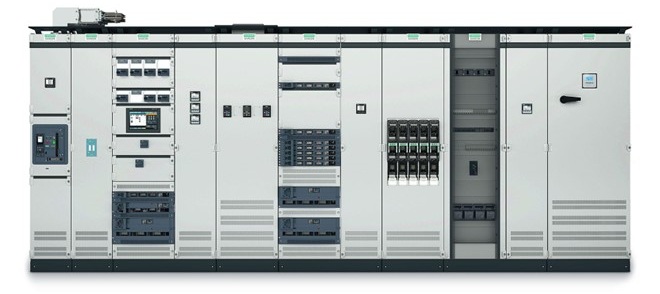
Siemens Sivacon S8 Low Voltage System Example
In addition to the internal lockings described above, lower station upper station locking should also be considered. In this type of structure, what is specifically meant by the upper station is the busbar system that contains the output cell that feeds a busbar system. Here, the substation can be considered as the fed busbar. In this type of systems, interlocks are made between the relevant output cell of the upper station feeding the lower station and the input cell(s) of the lower station. Upper station – lower station interlocking can be done between various voltage levels, and since voltage levels differ in terms of busbar properties, the required applications must be provided. For example, busbar systems at voltage levels of 154kV and above are generally designed as a dual busbar system. In addition, medium voltage systems can be preferred in businesses as a single or double busbar system. An example of this type of application is shown below with the help of logical structures. Of course, the example given in this figure was designed to meet the general requirements for a facility. It can be taken as a reference to give an idea. Here, the conditions under which the breakers, disconnectors and earth separators for the service position and test position will be activated in the upper and lower station locking are determined. Service position refers to the operating position where the system is under voltage and load. In this position, the grounding switch is open and the disconnector and breaker are closed. In the test position, in order not to energize the circuit to enable tests to be carried out during maintenance and repair, the separator is open, and the earth separator in the output unit is closed, and the breaker can be opened and closed separately.
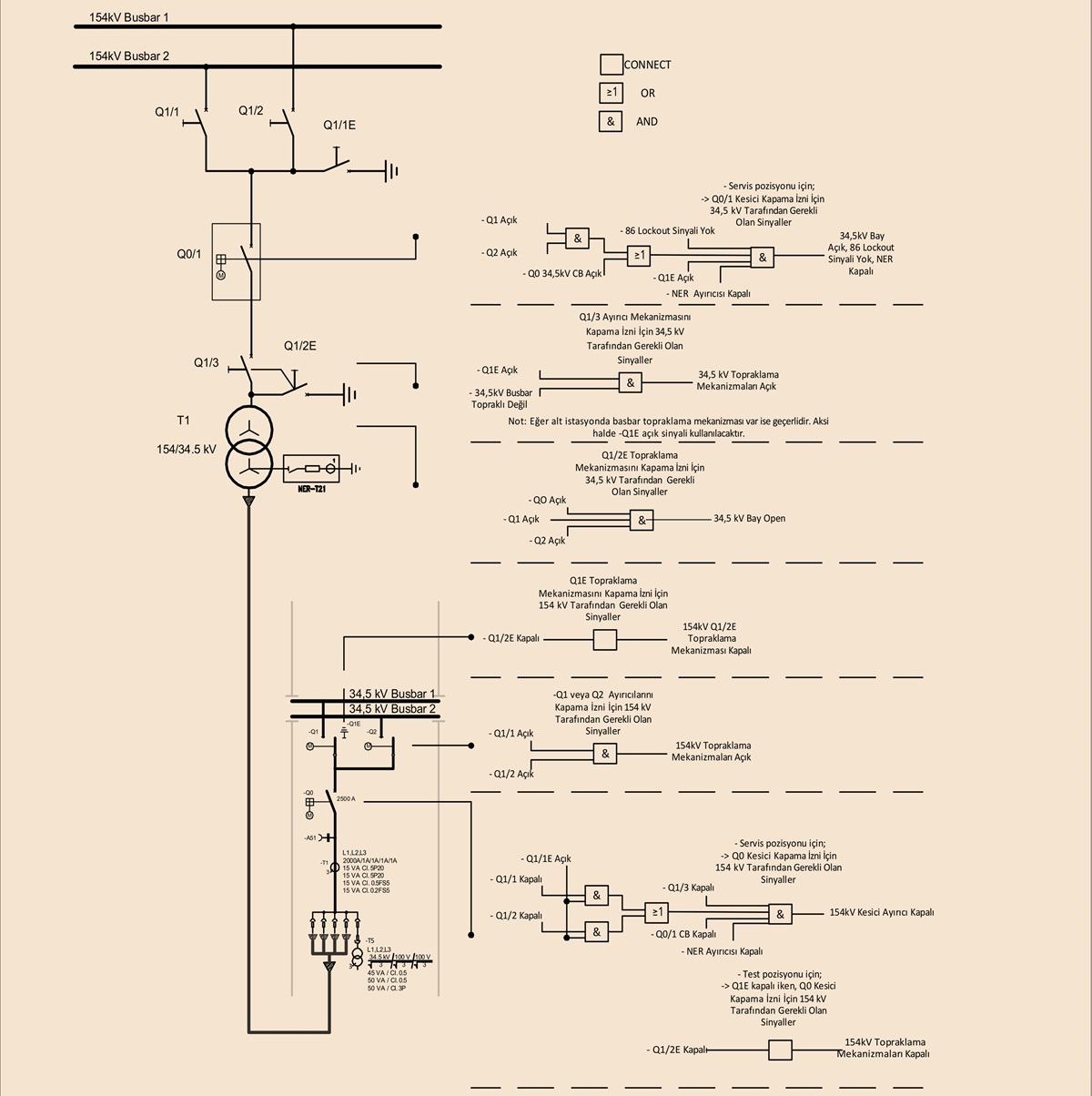
Example of interlocks between 154kV dual busbar system – 34.5kV dual busbar system
Siemens medium voltage, low voltage panels and design/solution engineering units offer panel and engineering solutions designed to lock all kinds of switching elements and facilitate the implementation of LOTO applications, in addition to providing both their own internal locking and special locking elements when needed, in health, safety and environment issues, which are one of the main issues that Siemens attaches importance to.